
For years, WordPress development has followed a familiar pattern.
A user performs an action in the dashboard, WordPress executes some PHP, plugins extend the functionality, and external systems communicate through APIs.
AI is starting to change that model.
Instead of an AI assistant simply telling a developer what code to write, we’re moving toward AI agents that can discover what a WordPress website is capable of doing and—when given permission—perform those actions.
One of the technologies making this possible is Model Context Protocol (MCP). And WordPress is now actively building around it.
First: What Is MCP?
Model Context Protocol provides a standardized way for AI applications to connect with external tools and data.
Think about the difference this way:
- Traditional workflow: Developer → AI Chat → Copy Code → WordPress
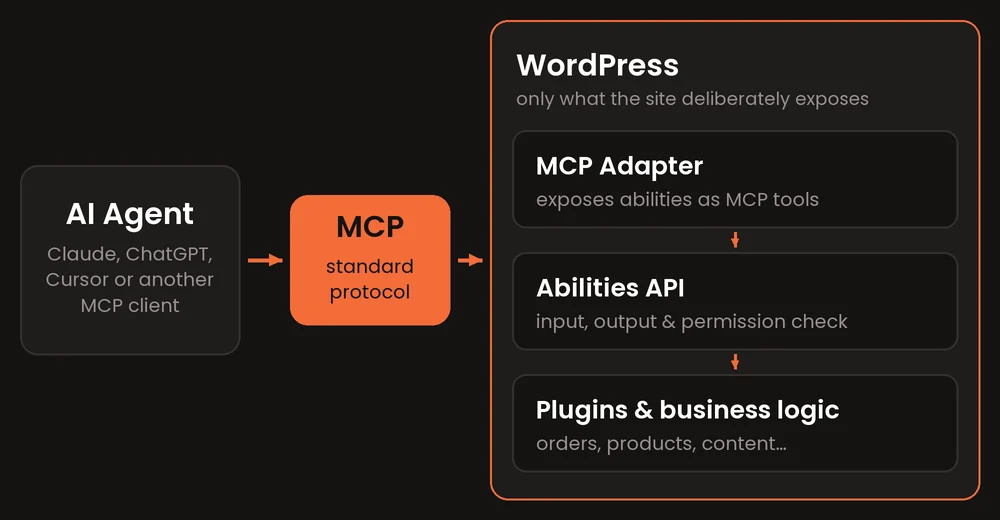
- Agent-based workflow: Developer → AI Agent → MCP → WordPress Abilities → WordPress
The second approach is much more interesting. Instead of copying information between WordPress and an AI assistant, the AI can potentially discover tools that the website deliberately exposes to it.
WordPress’ MCP Adapter is designed to translate WordPress abilities into tools that MCP-compatible AI applications can discover and execute.
The WordPress Abilities API Is an Important Part of This
WordPress introduced the Abilities API in WordPress 6.9. It provides a standardized way for WordPress itself and plugins to describe functionality they provide.
An ability can define what it does, what input it requires, what output it returns, and who has permission to execute it.
For example, imagine an eCommerce plugin registering abilities such as:
store/get-sales-reportstore/get-orderstore/check-low-stockstore/update-product-description
An AI agent doesn’t necessarily need to understand all the internal PHP behind those operations. It needs to know that the abilities exist, what parameters they accept, and whether it has permission to execute them.
The WordPress MCP Adapter can expose abilities that have been explicitly opted in as MCP tools, so external AI clients can discover and use them.
This Is Already More Than an Experiment
WordPress has continued building its AI infrastructure during 2026. The platform’s AI building blocks include the Abilities API, AI Client, MCP Adapter and AI plugin.
The AI Client is especially interesting because it gives developers a provider-independent way to interact with AI models rather than designing an integration around only one AI company.
Conceptually, one side of the architecture can look like: WordPress Plugin → WordPress AI Client → Available AI Provider.
Another side can look like: Claude / ChatGPT / Cursor / Other Agent → MCP → WordPress MCP Adapter → WordPress Abilities → Plugin / Business Logic.
This separation could make AI functionality much easier to maintain over time.
What Could We Actually Build With It?
This is where things become useful for businesses rather than simply technically interesting.
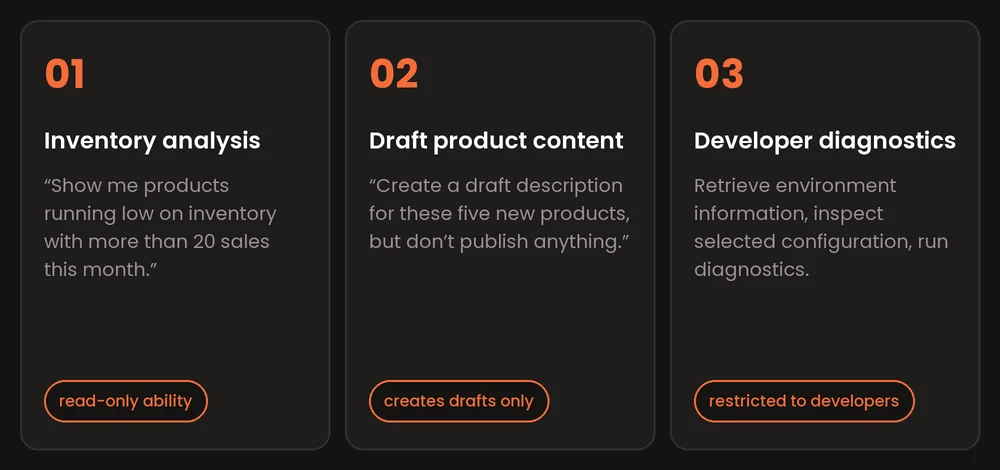
Imagine an eCommerce manager asking: “Show me products that are running low on inventory and had more than 20 sales this month.”
An appropriately designed agent could retrieve that information through approved abilities instead of someone manually exporting data and feeding a spreadsheet into an AI.
Or imagine saying: “Create a draft product description for these five new products, but don’t publish anything.”
The agent could retrieve the products, generate descriptions and create drafts—provided those exact capabilities were intentionally exposed and permitted.
For developers, an agent could potentially retrieve environment information, inspect selected configuration, run diagnostics or execute custom development tools.
The important architectural idea is that one underlying ability can potentially be reused across the dashboard, REST-based workflows and AI-agent interfaces rather than implementing the business logic separately each time.
AI Agents Shouldn’t Have Unlimited Access
There is an important security issue here. Connecting an AI agent to WordPress should not mean giving it unrestricted administrator access.
An agent that only needs to analyze orders shouldn’t also be capable of deleting plugins or users.
For production websites, the principle should be simple:
Give an AI agent the minimum access required to perform its job.
Use capability checks, dedicated users with limited permissions, read-only abilities where appropriate, extra care around destructive operations, and monitoring or logging.
The same principle already applies to users, APIs, databases and cloud infrastructure—it’s the same thinking behind building payment systems with PCI DSS in mind. AI agents shouldn’t be treated differently.
What This Could Mean for WordPress Development
I don’t think the interesting future is: “AI will build every WordPress website.”
The more interesting future is that websites themselves become machine-operable platforms.
A WordPress website might expose carefully controlled capabilities to humans, internal automation and AI agents simultaneously.
The roadmap to WordPress 7.2 includes continued experimentation around abilities, MCP improvements, easier MCP access, agent identity and delegation, semantic search, reusable site knowledge and streaming AI responses. That work is happening in the AI plugin, without a guarantee of landing in 7.2—and as with any roadmap, experimental features still need to prove their value before becoming permanent parts of Core.
Why I’m Paying Attention to It
I’ve spent years working with websites, eCommerce platforms, APIs, plugins and integrations.
A large part of custom development has always been about making System A communicate safely with System B. AI agents introduce another participant into that architecture.
The interesting challenge for developers won’t just be generating code with AI. It will be designing systems where AI can safely understand data, use tools and perform useful actions without giving it control over things it shouldn’t touch.
MCP, WordPress Abilities and the new AI APIs are early pieces of that architecture.
And I think this is a much more important development than simply adding another AI chatbot to a website.
The next stage of AI-powered web development may not be websites that talk to us. It may be websites that AI agents can actually work with.
Further Reading
- The Abilities API — Learn WordPress
- From Abilities to AI Agents: Introducing the WordPress MCP Adapter — WordPress Developer Blog
- Build your first AI-Powered WordPress plugin — WordPress Developer Blog
- Roadmap to 7.2 — Make WordPress Core